The cultural fears and misunderstandings surrounding mental illness in the nineteenth century didn’t just shape medical treatment and social perception, but also the world of literature. Gothic literature of the era often absorbed, dramatized, and reinterpreted these fears, transforming clinical misunderstandings and social prejudices into powerful narratives. As a result, literary depictions of madness from this period revealed the assumptions, anxieties, and blind spots that governed public understanding of mental health. This genre often used madness, isolation, bodily decline, and unstable perception to explore the darker corners of the human mind. Writers drew heavily on the period’s beliefs about mental illness and blended them with Gothic elements. While Gothic literature embraced supernatural elements, it was equally preoccupied with the psychological and medical theories circulating in the nineteenth century. Authors such as Charlotte Perkins Gilman transformed these cultural anxieties into narrative experiments, using madness not simply as a plot device but as a lens through which to critique, expose, or embody the period’s misconceptions about the human mind.
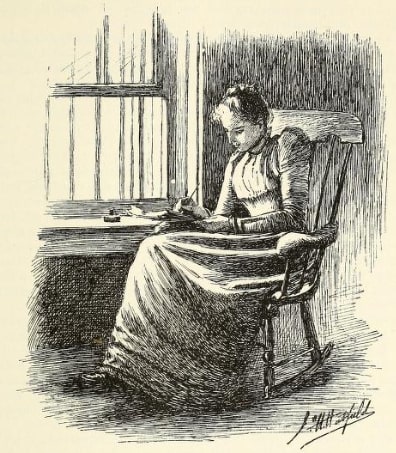
Charlotte Perkins Gilman wrote “The Yellow Wallpaper” in 1892 after her own personal experiences with misogynistic medical practices and the dreaded “rest cure.” The story operates not only as a fictional account of a woman’s psychological unraveling, but also as a critique of patriarchal medicine pathologizing women and systematically silencing them. The narrator of the story is forbidden from intellectual activity—as the rest cure prescribes—and therefore she must write in secret. Her entries chart the slow erosion of her autonomy and sense of self, illustrating how the rest cure itself creates the very “madness” it claims to treat.
The narrator in “The Yellow Wallpaper” is left unnamed and intentionally portrayed as a woman to comment on the unfair treatment of women who are diagnosed with some kind of mental illness. She is unnamed because she is unrecognized. Her experiences are dismissed, her words are ignored, and her selfhood is diminished by the structures meant to “care” for her. Gilman uses this choice to highlight that the narrator’s situation is not an isolated tragedy, but an everyday reality for countless women whose symptoms were interpreted through the lens of misogyny rather than medicine.
The narrator’s husband, John, is a physician who wields absolute power over her treatment and daily existence. Throughout the short story, John belittles the narrator by calling her names like “blessed little goose” (Gilman 5) and “little girl” (11), which infantilize her, reinforcing his authority while undermining her credibility and maturity. Within the first few sentences of the short story, the narrator shares that “John laughs at me, of course, but one expects that in marriage” (1). This only exposes how deeply normalized this dynamic is. The narrator has internalized the idea that male condescension is simply part of marital life, underscoring how patriarchy works not only through domination but through social conditioning. She goes on to share that he “does not believe I am sick!” (2) and that he shared with their friends and relatives that “there is really nothing the matter with one but temporary nervous depression—a slight hysterical tendency” (2). These statements immediately show that her husband, the physician, does not believe nor treat her symptoms as a true mental illness. She even states that “He knows there is no reason to suffer… it is only nervousness” (5).
The narrator is staying in a house for the summer, and she finds herself staying in the nursery. Unbeknownst to her, she is staying in a controlled environment specifically for her to undergo her rest cure. The narrator believes that she is staying in an innocent nursery with windows that are “barred for little children” (Gilman 4), “rings and things in the walls” (4), and “this great immovable bed—it is nailed down, I believe” (8). These details reveal that this room was designed to contain someone, specifically the narrator, as she undergoes her treatment. Other details prove that the narrator has undergone this treatment before: “the paint and paper [that] look as if a boys’ school had used it. It is stripped off—the paper—in great patches all around the head of my bed, about as far as I can reach” (4). The paper was peeled off specifically as far as she could reach, indicating that she had been the one to peel it. Clearly, the previous rest cure she had endured did not work, as the story takes place with her returning after being prescribed it a second time.
Of course, there is the question of the yellow wallpaper. The narrator is appalled by the wallpaper that adorns the bedroom she is staying in, and her thoughts and hatred of it haunt the entire story. She constantly references “that horrid paper” (Gilman 5) and tries to make sense of the pattern. Rather than understanding it, however, she begins to see a woman creeping behind the first pattern, which acts as a prison. The moment the narrator perceives this woman is the moment the wallpaper shifts from being an annoyance to a metaphor. The first layer of the wallpaper can be understood as the societal expectations imposed on women like the narrator. Obedience, cheerfulness, domesticity, and unquestioning trust in male authority are expectations that act as a prison for women (Sustana). The creeping woman behind it represents not only the narrator’s deteriorating mental state but also the broader suffocation of women under rigid gender roles. Her husband and society define her recovery not by actual improvement but by how quickly she returns to her assigned duties as wife and mother (Sustana). Anything that deviates from domesticity, like writing, thinking, creating, or questioning, is labeled dangerous. So, when she becomes obsessed with “freeing” the woman in the wallpaper, she is also attempting to free a version of herself who resists captivity and refuses to fit neatly into the domestic pattern she is expected to inhabit. The wallpaper becomes a battleground where she fights for a voice she is denied everywhere else.